Showing posts with label Agatha Christie. Show all posts

Tuesday, 7 April 2026

Reading Agatha Christie in Publication Order: full list and progress


I've had it in mind for years to do a full reread of all the Christies. I'm sure I've read them all at some point - mainly as a teenager in between PG Wodehouse and, later, Stephen King - but I don't remember much about most of them. Well, it was a long time ago, and I've read a lot of books since.

After finishing Laura Thompson's biography (my review here), I got the idea into my head to read the whole lot (i.e. the novels and main short story collections) in publication order. And blether about them on my blog, because why not. So...that's the plan. I'm not sure yet if I'll incorporate the Westmacotts in order or leave them to the end.... I'll see how it goes. (UPDATE: I'm going to leave them to the end, but I *am* definitely going to read them.)

I'm not promising there'll be no spoilers along the way, but I’ll try not to include any major ones.

Full list to date....

Monday, 30 March 2026

Reading Agatha Christie in Order Book 11: Partners in Crime


First published: 1929. Christie's eleventh book overall and second short story collection. This is the second outing, following 1922´s The Secret Adversary, for those young adventurers Tommy and Tuppence - now Mr and Mrs Beresford.

Title: Quite dynamic. Taken with this vintage cover, it kind of looks like they're the ones committing the crimes, which isn't generally the case. Actually, I'm not at all sure what's going on in this cover picture. Why is the dog there? Why is there some kind of shadow monster involved? Mysterious.

Plot: Tommy is "more or less in the Secret Service now, but it's pure office work", according to his wife. Tuppence, meanwhile, unsuited to the role of housewife, yearns for something exciting to happen. ("This craving for vulgar sensation alarms me," observes Tommy reprovingly.) Something exciting does indeed happen, when they more or less accidentally take over a detective agency, Blunt's Brilliant Detectives. (Really it's at the behest of Tommy's boss at MI5 or wherever, and there's an overarching plot which is something to do with Russians and the number 16. I'm still not entirely sure what that was all about.)

Anyway, the T's, together with Albert as office boy, are soon installed in "a somewhat dilapidated building in Bloomsbury", ready to undertake any private detective business that comes through the door while waiting for the number 16 thing to happen. 

Tommy decides, for amusement, to model himself on a succession of famous fictional detectives; most of these are long forgotten (Thornley Colton? the Okewood brothers? anyone?), although both Sherlock Holmes and a certain M. Hercule Poirot (and his little grey cells) get a mention. I've definitely heard of them.

The investigations range from murder to the rather less lethal - a man trying to track down his fiancée, another trying to solve his girlfriend's challenge of figuring out how she could have been in two places at one time. (The solution is... disappointing.)  Ultimately the number 16 stuff comes to fruition, with danger on all sides. And it ends with the promise of a new chapter in the life of Mr and Mrs Beresford.

Americans with silly names: Mrs Cortlandt Van Snyder of Detroit. (Russians with silly names: Prince Vladiroffsky.)

Acceptable in the 20s? I didn't notice any issues - at least, not in the cheap modern e-book edition I have. It's always possible it's been bowdlerised, though. 

VerdictI was looking forward to this - short stories make a change, and I know they're not everyone's cup of tea but personally I find Tommy and Tuppence quite fun. I like their sparky dialogue. However, I didn't enjoy it as much as I thought I would - the stories are very inconsequential, and nothing that happened really stuck in my mind. 

There is some fun dialogue, though - I liked this exchange between Tuppence and a young woman, Monica, who the agency helps- I'm not sure Tuppence is entirely correct, but it does seem to happen a lot in the fiction of the time!

 "Well - there are two men who - who - want to marry me." [said Monica]

"The usual story, I suppose? One rich, one poor, and the poor one is the one you like!" 

"I don't know how you know all these things," murmured the girl. 

"That's a sort of law of Nature," explained Tuppence. "It happens to everybody. It happened to me."


Next up: The Mysterious Mr Quin. This should be intriguing...

Thursday, 26 March 2026

Reading Agatha Christie in Order: Book 10: The Seven Dials Mystery


Preceded by: The Mystery of the Blue Train

First published: 1929. It seems crazy that that's not far off a century ago. This edition, however, with an introduction by Val McDermid, is a tie-in to the 2026 Netflix series. Which I did watch quite recently, so was interested to see how it compared with the novel. I've read it before, of course - I've read them all at some point in my life - but far too long ago to remember. I think I had it mixed up in my mind with The Clocks, which I guess is understandable, title-wise.

Title
: Just "Seven Dials" on the cover, in the new Netflix tie-in edition. But I'll stick with The Seven Dials Mystery, as Agatha intended.

Plot: We're back at Chimneys - oh joy! I'm not sure it merited a revisit, but here we are again with Lord Caterham, his daughter Lady Eileen "Bundle" Brent, Bill Eversleigh, etc. 

When young Gerald Wade is found dead in his room at Chimneys, unawoken by the alarm clocks ("alarum" clocks in the text) his friends have placed there as a joke, young Bundle - an energetic young woman with a penchant for danger - suspects something's afoot. (Unlike in the TV series, there's no romantic relationship between them.) The words "seven dials" keep coming up, and soon there's word of another mysterious multinational secret society, which is a bit reminiscent of the Big Four. Soon, Bundle is scampering about right left and centre in the pursuit of what's really going on, from seedy nightclubs to political gatherings. There's definitely surprises along the way - including a hilariously unexpected proposal. The audacity!

Silly names watch: There's a girl known for no apparent reason as Socks (real name: Vera Daventry). Her obsession with using the word "subtle" at every opportunity is quite amusing. Another character, Rupert Bateman, is known as "Pongo".

Acceptable in the 20s? There's the usual patronising attitude to the lower classes. Though the upper classes are mainly dimwits, so. The self-made rich, represented here by Sir Oswald and Lady Coote, are also rather looked down upon, incapable of the "delicate appreciations of life" enjoyed by the upper-class likes of Lord Caterham.

And there're the usual uncomfortable references to people being Jewish, with references to "Jewesses" in a nightclub, and the likes of this -

    "I may be an ass," said Jimmy. "I daresay I am. But I won't have Russian Jews saying so."


Verdict:
In her autobiography, Christie describes this book as "the light-hearted thriller type", which didn't need too much in the way of plotting. Light-hearted it definitely is - clearly, none of this is meant to be taken too seriously. The adventurey species of Christie books aren't really my favourite - I'm quite often not entirely sure what's going on, or why - but I liked this better than Chimneys or The Big Four, and the solution is both unexpected and fun.

Comparisons to Wodehouse felt a little more justified here than in Chimneys, though Christie isn't as funny a writer (but hardly anybody is). There's a good selection of vacuous young men (one of whom is described as a "purely ornamental excrescence", very Wodehousian!), a dynamic trouble-causing heroine in the shape of Bundle Brent, and some good lines. Some of my highlighted quotes -

    "Perhaps George is going to be assassinated," said Lord Caterham hopefully.

And this delightful exchange -

    "It's an extraordinary thing" [said Gerry Wade], "but wherever I happen to be staying, I'm always last to be down [to breakfast]."

    "Very extraordinary," said Lady Coote.

    "I don't know why it is," said Mr Wade, meditating. "I can't think, I'm sure."

    "Why don't you just get up?" suggested Lady Coote.

    "Oh!" said Mr Wade. The simplicity of the solution rather took him aback.


Up next: Partners in Crime. It's Tommy and Tuppence again!

Friday, 13 March 2026

Reading Agatha Christie in Order: Book 9: The Mystery of the Blue Train


Preceded by: The Big Four

First published: 1928. Christie's ninth book, eighth novel, and sixth featuring Poirot. Again, her life wasn't in the best place during its writing - she was still deeply affected by the breakup of her marriage and the death of her mother, and reportedly considered The Mystery of the Blue Train to be her least favourite of her books. 

Title: Pretty standard. Le Train Bleu was a French luxury night express train, favoured by the rich and famous, which operated from 1886 to 2003 between Calais and the French Riviera (thank you, Wikipedia).

Plot: It's a bit of an odd one. Numerous characters are introduced in the first part of the book, not all of whom will be ever mentioned again. First we're in the backstreets of Paris where an exchange of goods is taking place, then meeting a Greek antique dealer and a mysterious man with white hair known as M. le Marquis, then at the Savoy with a rich American (Christie's Americans are always rich), his daughter Ruth and her unsatisfactory husband. Then suddenly we're in St Mary Mead with Katherine Grey (but Miss Marple is nowhere to be seen). Then we're in the French Riviera with Lady Tamplin, her fourth husband and her daughter Lenox. (An unusual name, I thought. Ruth's husband is named "Derek", which I didn't know was popular in the 1920s.)

The eponymous Blue Train doesn't appear till around a quarter of the way through - neither does (the allegedly now retired) Poirot. To be honest, I forgot he was supposed to be in it for ages, though once he turns up, he does play a large role. Hastings is absent and unmentioned, aside from one passing reference.

Once all these disparate elements started coming together, I quite enjoyed it. Katherine is our heroine: a formerly penniless companion who has come into money, an intelligent and reflective young woman whose calm grey eyes seem particularly alluring to the various men she meets. An encounter on the Blue Train draws her into murder and mystery. 

The plot - jewel theft, murder, various comings and goings on the train - is a little complicated. I did suspect one person, but was still surprised when the identity of the "Marquis" was revealed.

There are hints of romance for certain characters, but it was impossible to predict exactly how it would turn out.


Poirot-isms: His avuncular relationship with Katherine is quite sweet. He's as self-effacing as ever, of course:

    "I am Hercule Poirot."

    "Yes, Monsieur?"

    "You do not know the name?"

    "I have never heard it."

    "Permit me to say that you have been badly educated. It is the name of one of         the great ones of this world."


Acceptable in the 20s? I don't think there's anything too jarring. Some national stereotypes and unnecessary references to people being Jewish, but nothing majorly offensive. 

I enjoyed this description of Lady Tamplin's dopily amiable fourth husband, known as "Chubby":

    "He was one of those staunch patriotic Britons who, having made a portion of a         foreign country their own, strongly resent the original inhabitants of it." 

Plus que change, etc.

 
Americans with Silly Names Watch: None. Rufus Van Aldin is this book's resident American millionaire, but his name isn't particularly ludicrous. There's a Frenchman called Armand de la Roche, which is rather marvellous. And the aforementioned Lenox Tamplin, but she's not American. 


Verdict: I liked it better than The Big Four, which isn't saying much. Christie herself deemed it her least favourite story, but I think there are more deserving candidates for the dubious accolade of her worst. Interesting to get an early reference to St Mary Mead - Christie clearly (and rightly) liked the name well enough to adopt it for Miss Marple's village. (It also marks the first appearance of Poirot's valet, George, or "Georges" as he calls him.)


Wednesday, 11 March 2026

Reading Agatha Christie in Order: Book 8 : The Big Four


First published: 1927. Christie's eighth book, seventh novel, and fifth outing for Poirot.

Title: Moderately intriguing, I suppose. Who or what are the Big Four?

Agatha wasn't having a happy time during the writing and publication of this - reeling from both the death of her mother and the breakdown of her marriage due to her husband's infidelity. The book itself came out just a few weeks after her famous disappearance. 

I've been putting off reading it for a while, because I don't have especially fond memories of it (actually I barely have any memories of it apart from it being a drag to get through) and I'm really not keen on this particular species of Christie (even though it does in this case have Poirot in it, which is a minor saving grace). It's another one where there's a shadowy figure (or four, in this case) of extraordinary power behind all manner of world unrest, revolutions, etc. (Lenin and Trotsky, for instance, are "mere puppets whose every action was dictated by another's brain".) 

"Oh come," [protests Hastings], "isn't that a bit far-fetched?"

For once, I'm with the Captain on this one.

Anyway, Hastings is back from South America after eighteen months to carry out some unspecified business, and looks up his old friend Poirot. (His wife is left behind in Argentina for several months, so I'm not sure how she feels about that.) Following a rapturous welcome from Poirot, the two old friends are almost immediately caught up in danger and adventure, with the number four continually popping up right, left and centre.

It does feature Hastings briefly going undercover in the household of an American millionaire, which is fun. Ryland’s household includes a valet called Deaves with an “irreproachable manner”, surely a nod to the ineffable PG Wodehouse, whose similarly irreproachably-mannered and similarly-named Jeeves had been appearing in short stories for a number of years at this point. 

Oh, and Poirot is dead at one point. He has a funeral and everything.


Poirot-isms 

"But for my quick eyes, the eyes of a cat, Hercule Poirot might now be crushed out of existence - a terrible calamity for the world. And you too, mon ami - though that would not be such a national catastrophe."

"We are dealing with the second greatest brain in the world." [No need to ask who the first greatest is, of course.]


Americans with Silly Names Watch: "Richest man in the world" Abe Ryland is known as the American Soap King, but his actual name isn't particularly silly.


Acceptable in the 20s? The less said about the representation of Chinese people here, the better. Hastings’ comment that he can’t tell one “Chinaman” from another is in fact one of the less offensive stereotypes here, which probably tells you everything you need to know.

Hastings has some unreconstructed views on women scientists:

"It has always seemed to me so extraordinary that a woman should go so far in the scientific world. I should have thought a purely masculine brain was needed for such work."

But as the woman in question is described by Poirot and others as an incredible genius, it’s clear the Captain is in the minority here and his views on this, at least, probably don’t reflect the author’s.


Final verdict

Slightly more enjoyable than I expected, after detesting The Secret of Chimneys so much. It feels more like a Tommy and Tuppence than a Poirot, but he’s probably its saving grace.


Monday, 12 October 2020

Reading Agatha Christie in Order: Book 7: The Murder of Roger Ackroyd


Preceded by: The Secret of Chimneys


First published: 1926. Christie's seventh book, sixth novel, and fourth (including the short story collection Poirot Investigates) to feature the little egg-shaped-headed one. 


Title: Another does-what-it-says-on-the-tin. There's a bloke called Roger Ackroyd and he does indeed get murdered. 


Background: Probably the first of the “big name” books - the ones most people have heard of, and the first to really mess with the established rules of the murder mystery. It also represents a setting which many people associate with Christie: no international jewel thieves or shadowy world-taker-overers here, just a murder or two in a country village - King's Abbot - where the inhabitants' "hobbies and recreations can be summed up in the one word: gossip". And it features the already-popular Poirot, though no Hastings to provide dim-witted sidekickery, the Hastings/Watson role here being taken by local GP Dr Sheppard, who narrates the story.


Plot: Poirot has retired to King’s Abbot, supposedly, in order to grow vegetable marrows (we know that's not going to last) and Hastings has got married and popped off to "the Argentine". Poirot's keeping quiet about his former profession and is generally presumed locally to have been a hairdresser named Mr Porrott. Unfortunately for his retirement plans, two deaths in rapid succession, of which the second - Ackroyd's - is most definitely murder, require him to dust off the little grey cells, leave the vegetable marrows to their own devices and annoy the local police (including the "weaselly" Inspector Raglan) by getting stuck into the investigation. 


I love Christie's character descriptions. They may lack a certain depth, but they really give you a lasting impression of the person. Ackroyd's housekeeper, Miss Russell, is


"a tall woman, handsome but forbidding in appearance. She has a stern eye, and lips that shut tightly, and I feel that if I were an under housemaid or a kitchenmaid I should run for my life whenever I heard her coming."


Sheppard's sister Caroline is one of those very Christie-esque spinsters who knows nearly everything about everyone without needing to leave the house, a type later to resurface more famously, and with more finely honed detection skills, as Miss Marple.


"The motto of the mongoose family, so Mr Kipling tells us, is 'Go and find out'. If Caroline ever adopts a crest, I should certainly suggest a mongoose rampant. One might omit the first part of the motto. Caroline can do any amount of finding out by sitting placidly at home."

Caroline also gets some great lines. 

'"Never worry about what you say to a man," [said Caroline]. "They're so conceited that they never believe you mean it if it's unflattering."'

 I mean, she's not completely wrong.

Poirot himself is introduced as follows, after hurling a vegetable marrow over the wall into his neighbour's garden:


"An egg-shaped head, partially covered with suspiciously black hair, two immense moustaches, and a pair of watchful eyes. It was our mysterious neighbour, Mr Porrott."


Acceptable in the 20s? A passing reference to "Semitic" moneylenders and a big-game hunter's mention of natives and their tom-toms, but I think that's about it. 


Verdict 

Roger Ackroyd was once voted the best crime novel ever by the Crime Writers' Association - quite an accolade. It certainly has a claim to be one of the most influential. When you read the story with knowledge of the solution, the clues and red herrings seem obvious, but it's so beautifully done that I doubt many first-time readers would spot it, and while the major twist has certainly been done since, it was undoubtedly ground-breaking at the time and was apparently greeted with quite an outcry. Complaints of Christie not playing fair with the reader are, however, unjustified. She doesn't so much break as reinvent the rules, and there's nothing wrong with that.


A classic Christie concoction of murder, blackmail, secrets and lies, a houseful of suspects and more red herrings than you can shake a stick at. Beautifully constructed and essential reading for Christie aficionados and casual fans alike.


Next up: The Big Four. Can't say I'm overly enthused about this one, but I'm keeping an open mind.


Sunday, 27 September 2020

Reading Agatha Christie in Order: Book 6: The Secret of Chimneys


Preceded by: The Man in the Brown Suit


First published: 1925.


Good title? Meh.


Another “standalone” book lacking any of the usual sleuths. It does introduce the recurring character of Superintendent Battle. (Agatha seems to like dynamic-sounding nouns for the names of these characters - Race, Battle) but he’s hardly inspiring:


"a squarely built middle aged man with a face so singularly devoid of expression as to be quite remarkable."


Anyway, the story opens with a massive information dump about the history of “Herzoslovakia”, a fictional Balkan country, courtesy of two repulsive young men. (I wasn’t sure at the time if we were meant to find Jimmy and Anthony repulsive or not, but repulsive - and smug, and annoying - they most definitely were.) 


The racism in these first few pages was hard to get past, with derogatory references to “dagos” and “Hebraic financiers”.  There’s definitely a sense that only the Brits - the English, actually - are worth bothering about. Everyone else deserves contempt to a greater or lesser degree, indeed are rather less than human. It’s hard to know what to say about all this - it leaves a really nasty taste in the mouth. 


We then meet Virginia Revel, an alluring young widow who everyone’s in love with. Virginia has a nice name and I think she’s meant to be an appealing character, clever and witty and brave. She’s kind to a servant, offering to pay for a holiday for his wife to recover from an illness, but then “[cuts] short the man’s thanks with an impatient nod of the head”.  Servants in general, rather like foreigners, are patronised and disregarded. ("Hurry up Elise, there's a good girl" - Virginia to her maid.)


The plot is really a lot of nonsense about missing papers, a murder at the Chimneys country house  (nobody’s too upset, as the victim is a foreigner), the restoration of the monarchy in Herzoslovakia (democracy? who needs it?) and so on.


The tone is light hearted - it’s clearly in the genre of comedy thriller - and there are a few good lines, but I can’t honestly say I enjoyed it. I just couldn’t interest myself in the story or the characters. I can't even remember what the story was about. (It does improve a bit at the end, with - in the current parlance - a “jaw dropping twist I didn’t see coming”.) Some reviewers have referred to a comparison with P G Wodehouse, who I love, but I didn't get that at all - yes, there are a couple of funny lines and a lot of toffs, but the Wodehouse wit and charm is lacking.


While Christie was always on the conservative side (and would probably have been a Leave voter had she been alive today), we know from later work that she was capable of much greater complexity of thought than is shown here, where prejudices and assumptions go unchallenged.


I don’t think I’ve read this before (if I have, I’ve sensibly wiped it from my memory) and to be honest I kind of wish I hadn’t read it now. There’s a level of racism and snobbery on show here that far exceeds her previous books or any others I remember. Also, it's too long. Had it not been for the challenge I’ve set myself, I’m not sure I’d have finished it. I slogged through it in the interests of the challenge, and in faith of better books to come


Acceptable in the 20s?  See above.


Americans With Silly Names Watch: Hiram P. Fish, a collector of first editions.


Next up: The Murder of Roger Ackroyd. Now we're cooking with gas!


Tuesday, 22 September 2020

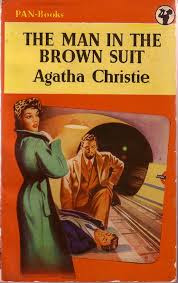
Reading Agatha Christie in Order Book 5: The Man in the Brown Suit


Preceded by: Poirot Investigates
First published  1924 - Christie’s fifth book, fourth novel, and the first “standalone” story not featuring any series characters (though it does introduce the occasional character of Colonel Race). People at the time were disappointed at the lack of Poirot, already a popular figure.

Good title?

Well, it initially had me visualising David Tennant as the Tenth Doctor, which is obviously not what Christie had in mind, unless she herself had a time machine. It’s okay, as a title. Who is the man, one wonders? What has he done to deserve to be in the title? Why is his suit brown? Etc.

Plot: Young Anne Beddingfeld’s life with her academic father - "one of England's greatest living authorities on Primitive Man" - has been less than thrilling so far, but she longs for adventure:

"I yearned for adventure, for love, for romance, and I seemed condemned to an existence of drab utility."

Indeed, Anne is a remarkably free spirit (she's not like other girls), thriving on passion and danger, both of which are in short supply in Little Hampsley. Her father's death allows Anne the opportunity to be let loose on the world, and a chance encounter on a station platform, potentially linked to a murder, soon see her aboard the Kilmorden Castle ship heading for Cape Town.


As Agatha herself had travelled to South Africa on the similarly named Kildonan Castle, we may suppose that she knows what she’s talking about here, though her journey was probably less eventful than Anne’s. The larger than life character of Sir Eustace Pedler, whose journals make up part of the narrative, is based, according to Laura Thompson's biography, on a Major Belcher, a bit of a nightmare for whom Agatha nevertheless had a sneaking fondness.

There’s some business about stolen diamonds, and a shadowy Mr Big (another one) but the details of the plot are probably less riveting than the general adventure and romance of it all, though the identity of Mr Big (confusingly codenamed "the Colonel", as there's another Colonel in the story though nobody ever really thinks it's him) may surprise you - it did me.

Speaking of which, Colonel Race ("a tall, soldierly-looking man with dark hair and a bronzed face... I put him down as one of the strong, silent men of Rhodesia") is probably the dullest of Christie’s recurring characters; indeed, of all the characters in the book, he's probably the one about whom I can least imagine a reader thinking "ooh, I hope we see him again!". Characters like Sir Eustace Pedler, Suzanne Blair and Anne herself would all be more worthy of a reappearance.

Arriving in South Africa, Anne finally feels her craving for travel and adventure is being fulfilled:

"I don't suppose that as long as I live I shall forget my first sight of Table Mountain.... It made me catch my breath and have that curious hungry pain inside that seizes one sometimes when one comes across something that's extra beautiful. I'm not very good at expressing these things, but I knew well enough that I had found, if only for a fleeting  moment, the thing that I had been looking for ever since I left Little Hampsley. Something new, something hitherto undreamed of, something that satisfied my aching hunger for romance."

"This is South Africa," I kept saying to myself industriously.... "You are seeing the world. This is the world. You are seeing it. Think of it, Anne Beddingfeld, you pudding-head. You're seeing the world." 

It's an emotion we can imagine the young Agatha herself experiencing.  

Anne Beddingfeld is an engaging character, if a little too addicted to danger (the story is a rollercoaster of kidnappings and boppings on the head and mysterious packages dropped through portholes in the middle of the night), and there's plenty of humour both in her narrative and that of Sir Eustace, who is an MP suffering from a plague of secretaries (he has three at various points).

Acceptable in the 20s?


South Africa is a remarkably white sounding place - Anne interacts little with anyone who isn't white and their existence barely registers in the story bar a few references to "natives”, who lack names or personalities. I think the only one dignified with a name is Batani, who helps look after Anne when she is incapacitated, and is referred to thus:

"Batani hovered about, counting no more than a dog might have done."

So that's nice.

A murdered woman is described as

 "the kind of woman who deserved to die. Men do all sorts of questionable things in order to get rich, but women shouldn't pretend to be in love when they aren't for ulterior motives."

I don't think they deserve to actually die for it, though, do they, Anne. Double standards much?

Leaving aside these deeply jarring moments, it's a good yarn, firmly in the adventure-romance category - while many of Christie's books have an element of romance, it's perhaps most pronounced here and is fairly strong stuff at times:

"Damn your French frocks." [says Anne's love interest] "Do you think I want to put frocks on you? I'm a damned sight more likely to want to tear them off you."

Fruity stuff for 1924!


Next up: The Secret of Chimneys. No idea what that's about.


Friday, 18 September 2020

Reading Agatha Christie in Order Book 4: Poirot Investigates


Preceded by: The Murder on the Links

First published

1924, a year after The Murder on the Links, but not necessarily set chronologically after it, since there's no mention of Hastings being in love or getting married or going to South America. All the stories had previously appeared in the magazine The Sketch, a society magazine which also included short stories and printed many by Christie. This was Christie's first published short story collection, and her third book overall to feature the already-popular Poirot.

Good title?

Does what it says on the tin. 

The plot(s) Eleven short stories in which Poirot, as advertised, investigates cases from a jewel robbery to an abducted Prime Minister (and most mysteriously of all, a suspiciously cheap London flat) and Hastings bumbles along in his wake, misunderstanding things and barking up the wrong tree.

The little Belgian has by now acquired a degree of celebrity in London:

"Oui, my friend, it is true - I am become the mode, the dernier cri! One says to another: 'Comment? You have lost your gold pencil-case? You must go to the little Belgian. He is too marvellous! Everyone goes!"

Not only has Poirot become a "pet society detective", his renown is such that even the British government calls him in to investigate when the Prime Minister is kidnapped. Hard to imagine that happening today. (I mean, who'd want Boris?) 

All the familiar elements are here; the gentle ridicule directed at Hastings brain power or the lack of it:

"Poirot," I said. "Am I quite demented?"

          "No, mon ami, but you are, as always, in a mental fog."

and the mystery-solving brilliance of Poirot's little grey cells. Indeed, in The Mystery of Hunter's Lodge, Poirot solves the whole thing from his sickbed, having dispatched Hastings to the scene to gather information. Other stories, though, take him further afield.

The Adventure of the Egyptian Tomb allows Agatha an early opportunity to exercise her interest in Egyptology, and also offers the enchanting spectacle of Poirot on a camel:

'He started by groans and lamentations and ended by shrieks, gesticulations and invocations to the Virgin Mary and every saint in the calendar. In the end, he descended ignominiously and finished the journey on a diminutive donkey.'

Interestingly, in a story called The Disappearance of Mr Davenheim, Christie once again foreshadows her own much-talked about "disappearance" a couple of years hence in 1926, with Poirot listing three types of disappearance, of which the second is "the much abused 'loss of memory' case - rare, but occasionally genuine". A couple of books earlier, The Secret Adversary also included such a case.

Acceptable in the 20s? Dodgy references to “Chinamen" in the first story (complete with pigtails and embroidered gowns), reference to superstitious "natives" in the Egypt one.

Verdict  Poirot Investigates is Christie's fourth published book, the third to feature Poirot and Hastings, and the first short story collection. I generally prefer her full length novels - the short story form doesn't really give space for the development of plot and character, presenting instead a puzzle to be solved. (Some people view all Christie's work like that, but those people are wrong.) 

That said, I liked the final story, The Case of the Missing Will, although it certainly fits into this "pure puzzle" category and although the story is slight and the title uninspired. In this story a young woman of intelligence and independence (Hastings, naturally, remarks that "I am not a great admirer of the so-called New Woman myself") employs Poirot to solve a conundrum regarding her uncle's will.

Worth a read, nevertheless, and I'll end with a favourite, quintessentially Poirot quote which I really need to find a way to work into my daily life.

"Strange." [Poirot murmured.] "We all have the little grey cells. And so few of us know how to use them."


Next up: The Man in the Brown Suit

Wednesday, 16 September 2020

Reading Agatha Christie in Order Book 3: The Murder on the Links


Preceded by: The Secret Adversary

First published 

1923, Agatha's third novel and the second to feature Poirot and Hastings.

Good title?

Is it Murder on the Links or The Murder on the Links? Nobody seems to know. Some editions have it one way, some the other. The latter seems more prevalent, though, so I'll stick with that. A reasonable workmanlike title anyway, in the great tradition of Murder on the This, Death on the That, etc, though I'm pretty sure I didn't know what "links" were when I first read it. Heck, I hardly knew what golf was. I was young. And, in fact, the title notwithstanding, golf plays no part in this story, so if you're looking for a golf-themed mystery you are, I'm afraid, doomed to disappointment. 

Anyway, after first being unleashed on the world in The Mysterious Affair at Styles, Poirot's back! (And Hastings. Him too.) And they're living together! (Not like that.) When Poirot is summoned to the French home of a millionaire, Paul Renauld, for reasons to be explained when they get there, he and Hastings arrive to find their correspondent (drum roll)… already dead! Poirot soon locks horns with the arrogant (probably insecure) Giraud of the Sûreté, who regards him as distinctly past it and has a good line in sneers. 

‘“I know you by name, Monsieur Poirot,” he said. You cut quite a figure in the old days, didn’t you? But methods are very different now.”

“Crimes, though, are very much the same,” remarked Poirot gently.’

 Needless to say, Poirot has the last laugh.

The plot is fast-paced, complicated and probably unguessable, with clues, suspects, daggers and dead bodies strewn around all over the place. It's all very French, with a different feel about it from Styles (and even more French phrases liberally sprinkled about than usual.) This is also the one where Hastings falls in love (and where his first name, Arthur, is finally mentioned... on the very last page). We are also treated to his views on women:

“Now I am old-fashioned. A woman, I consider, should be womanly. I have no patience with the modern neurotic girl who jazzes from morning to night, smokes like a chimney, and uses language which would make a Billingsgate fishwoman blush!”

He’s later challenged on it, though:

“Your idea of a woman is someone who gets on a chair and shrieks if she sees a mouse. That’s all prehistoric.”

You definitely get the impression "Cinderella" isn't going to put up with any of his nonsense.

Americans With Silly Names Watch: Hiram P. Trapp, although he’s only mentioned and never actually appears. Extremely wealthy, naturally. 

Poirot is, as always, very much himself - I've been struck already by how consistently he is characterised from the very beginning. Here, he is described by one character as:

“A small gentleman, well dressed, very neat, very spotless, the moustache very stiff, the head of a peculiar shape, and the eyes green.”

 And as far as his philosophy on detection goes, it's expounded here as clearly as anywhere:

‘“I do not run to and fro, making journeys, and agitating myself. My work is done from within - here -” he tapped his forehead significantly.’

I don't think many people would consider The Murder on the Links to be Christie's best work - the plot is a bit too complex - but there's lots of fun to be had nevertheless. 


Next up: Poirot Investigates


Thursday, 10 September 2020

Reading Agatha Christie in Order Book 2: The Secret Adversary


The Secret Adversary (a snappy title, thankfully not called The Mysterious Affair of the Missing Treaty or similar) is Agatha Christie's second published novel (in 1922) and the first to feature those bright young adventurers Tommy and Tuppence. Not everyone's cup of tea, I know - indeed, Robert Barnard in his book on Christie described them as "everyone's least favourite Christie sleuths". A little harsh.

They are swiftly introduced, both stony broke in the aftermath of the First World War - ex-V.A.D. Tuppence (aka Miss Prudence Cowley), the fifth daughter of an Archdeacon, desperate to avoid returning home to a world of "housework and mothers' meetings"; Tommy, a former soldier, now lacking both work and family after the death of his mother. I'm sure I must have read this before at some point, but I didn't remember it at all.

    "'Money, money, money!" [Tuppence bursts out, foreshadowing ABBA] "I think about money morning, noon and night! I dare say it's mercenary of me, but there it is!"

    "Same here," agreed Tommy with feeling.'

Relatable, for anyone who's ever experienced financial struggles.

In pursuit of the much needed cash, T&T decide to set themselves up as adventurers for hire, “no unreasonable offer refused”, possibly not a path down which most of us would choose to go, but I daresay it seemed like a good idea at the time. Sure enough, they’re soon mixed up in a frenetic plot involving secret government papers handed over for safekeeping to a mysterious American girl (Jane Finn, a name which everyone seems to regard as most peculiar, which is especially inexplicable given that one of the characters calls herself "Tuppence") during the sinking of the Lusitania.

Agatha's natural conservatism filters through, with some nonsense about "Bolshevists" fomenting red revolution in Britain ("Bolshevist gold pouring into the country" to this end, no less) and behind it all - behind literally everything in the world - a shadowy Mr Big, a mysterious master criminal of astounding power but unknown motive. The looming threats of a general strike and a Labour government hover darkly in the background as T&T set out in pursuit of the secret papers and the vanished Jane Finn.

All "good reactionary fun, if you're in the mood for that kind of thing", as Robert Barnard describes it.

Christie Xenophobia Watch: There are quite a few dodgy foreigners - a man described as a "Russian or a Pole" is unattractive, "fair, with a weak, unpleasant face" (and is amusingly called Boris). Germans get a poor press too, although that’s probably not surprising given the immediately post-war era. Americans, of course - the men, anyway - are rich and brash and called things like Julius P. Hersheimmer.

Curiously, given the unlikely explanation which would be offered a few years later for Agatha’s famous disappearance in 1926, a plot point here is that one character apparently suffers from amnesia...

Anyway, the plot is obviously preposterous and definitely intended as a fun romp of a thriller rather than the brilliantly plotted mysteries for which she became best known. (Agatha would return periodically to this type of story throughout her career.) That said, she keeps her secrets and misleads her readers well, and when the identity of “Mr Brown” is finally disclosed, out of all the possible suspects it wasn’t the one I’d expected. A talent to deceive, indeed - she led me right up the garden path.

T&T are widely regarded as being irritating, but I found their light-hearted, sparky dialogue fun, although as they’re apart for much of the story - both getting into separate lots of trouble - there’s less of it than there might be. And although allegedly just friends (from childhood), it will surprise no readers that they're engaged by the end of the story, set to embark on a married life which both confidently expect to be "a damned good sport!".

A story which is inevitably of its era -  a hundred years ago! - in many ways, betraying several of the attitudes one might expect. Nevertheless, Tuppence is definitely a modern young woman who brooks no nonsense, so I'll end by just leaving this here:

    '"I'll look after her, sir," said Tommy.

    "And I'll look after you," retorted Tuppence, resenting the manly assertion.'


Next up: #3 The Murder on the Links. Back to Poirot!